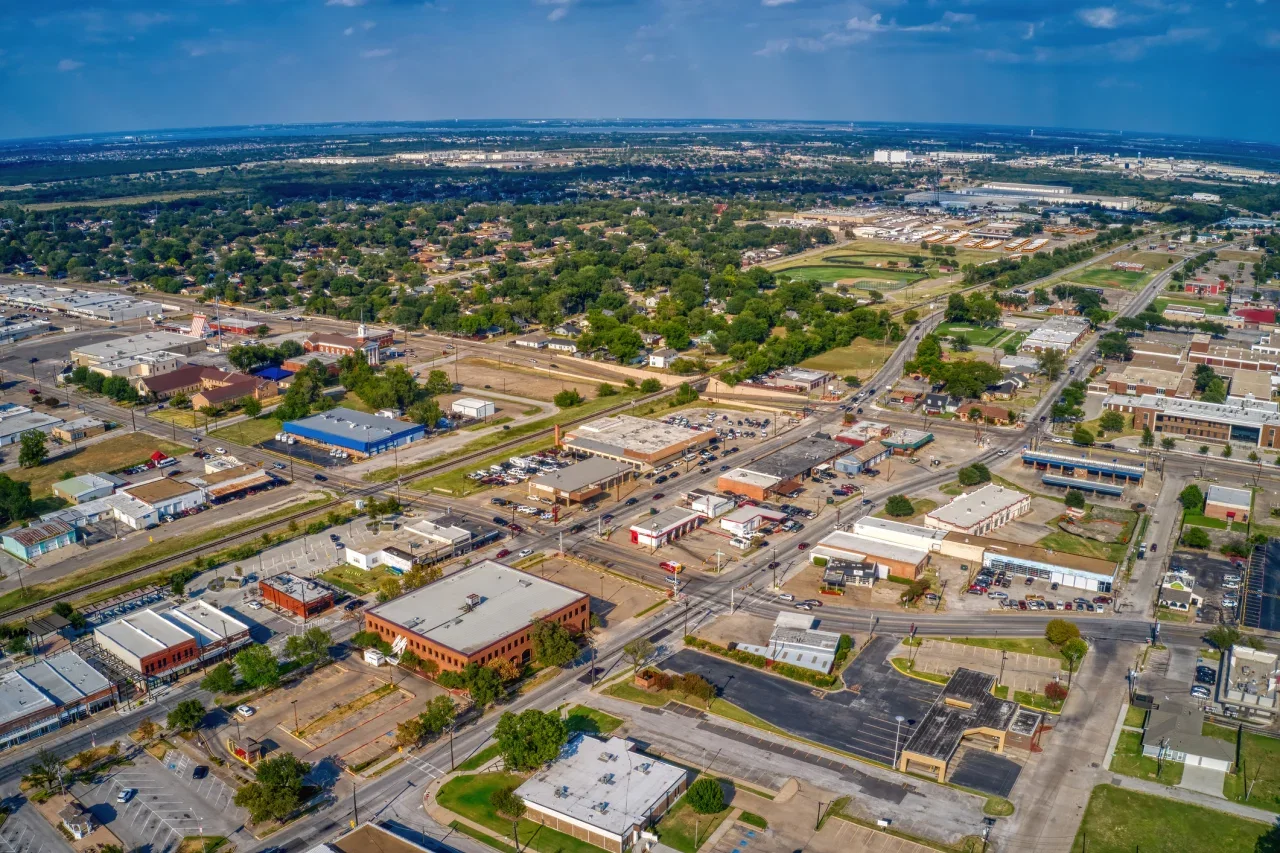
Mesquite's commercial inventory is dominated by 1970s-90s construction — Town East Mall and the surrounding strip retail, the Mesquite Arena complex, and a significant base of suburban commercial buildings that are well into replacement-cycle territory.
Mesquite's identity as the Rodeo Capital of Texas is tailored to the Mesquite Arena, which has hosted professional rodeo and draws a regional audience that supports a meaningful hospitality and retail ecosystem around the I-635 and US-80 corridors. That identity is real and it matters for roofing because the Mesquite Arena and its ancillary event-support buildings represent an unusual institutional roofing asset — large clear-span structures with complex rooflines and scheduling constraints that follow the rodeo and event calendar, not a standard construction window.
Town East Mall opened in 1971 on the I-635 and US-80 corridor and was a major regional retail anchor for decades. Like most regional malls built in that era, Town East has undergone significant renovation cycles and tenant reconfiguration. The original mall structure's roofing has been recovered and patched multiple times — in some sections the cumulative insulation depth exceeds structural load limits and requires full tear-to-deck replacement rather than another recover. The surrounding strip retail built in the 1980s to support the mall's gravity is in a similar position.
Mesquite doesn't have the dramatic growth story of the northern suburbs, but it has something equally important for our business: a mature commercial inventory that needs experienced replacement contractors, not the speculative new-construction contractors who followed the Frisco and McKinney growth booms north.
Town East Mall district (I-635 / US-80 / Town East Blvd): The mall structure itself plus the dense ring of strip retail, big-box, restaurant, and service commercial that surrounds it. The mall's original 1971 construction has been recovered multiple times — sections of the original structure may be carrying three or four roof systems stacked on top of each other. We pull cores to assess actual insulation depth and condition before committing to recover versus replacement. The surrounding 1980s strip retail is in active replacement cycle — 40-year-old modified bitumen on aging decks.
Mesquite Arena / Championship Rodeo complex (Military Pkwy / Rodeo Dr): The arena structure, the adjacent horse facilities, the parking-adjacent commercial and hospitality buildings. Unique scheduling constraints: the event calendar for the arena runs April through September and the rodeo season limits when we can stage materials and equipment on the surrounding paved areas. We pre-schedule arena-adjacent work for the off-season window when possible.
US-80 commercial corridor (east of Gross Rd): Mixed retail, auto-commercial, medical, and service buildings from the 1970s through the 2000s. This is bread-and-butter replacement territory — smaller commercial buildings with aging modified bitumen and early single-ply, owner-managed, where the replacement conversation is primarily about honest scope and fair pricing.
Mesquite Crossing and newer retail (Towne Centre Blvd / US-80): 2000s-era retail and restaurant buildings in better condition than the older stock. These buildings are in maintenance and early-replacement cycles — the leading edge of replacement needs, not the crisis end.
Mesquite is fully within the Blackland Prairie formation — among the deepest reactive-clay territory in Dallas County. The older commercial buildings in Mesquite, particularly the 1970s and 1980s strip retail and the Town East Mall structure, were built before modern geotechnical engineering for expansive soil was standard practice. Decades of foundation movement in reactive clay have produced visible problems in many of these buildings: parapet walls that lean, roof drains that no longer align with the low points of the deck, and structural joints that have compressed.
The I-20 storm corridor tracks directly through southern Dallas County and Mesquite, which puts the city in the path of significant hail events that generate south of the metro and track northeast. Older Mesquite commercial buildings with aged modified bitumen roofing are highly vulnerable to hail damage — the oxidized and brittle top-surface granules offer little impact protection and the aged cap sheet cracks under 1.5-inch stones that would barely mark a new 80-mil TPO.