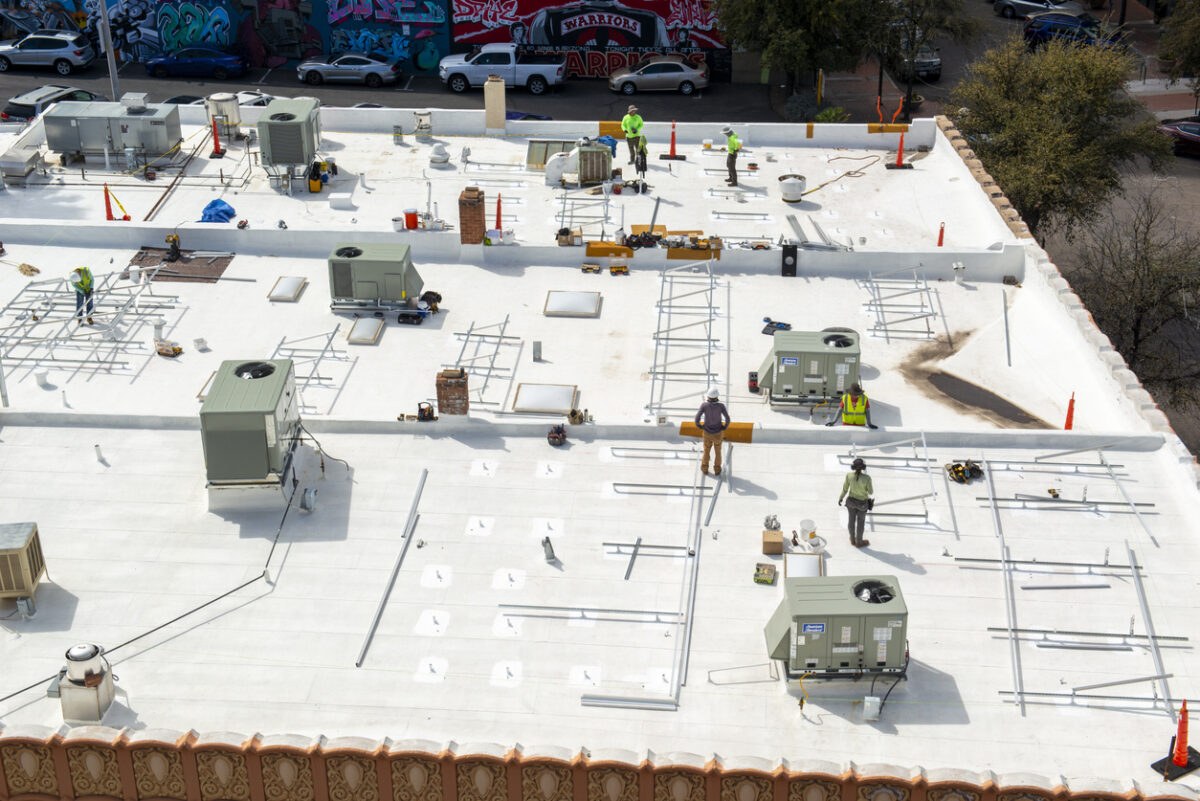
Commercial roofing for manufacturing plants, assembly facilities, and industrial buildings throughout Dallas, TX.
Dallas has quietly become one of the most active aerospace and defense manufacturing markets in the United States, led by Lockheed Martin's sprawling Aeronautics campus in nearby Fort Worth and supported by a web of precision parts suppliers, composite fabricators, and defense electronics firms distributed across the DFW metroplex. Facilities like L3Harris Technologies' Dallas operations and Raytheon's component manufacturing sites represent the kind of high-stakes manufacturing environment where roofing failures translate directly into production shutdowns, contamination events, and contract compliance problems.
Aerospace manufacturing plants in Dallas impose strict cleanliness requirements on any overhead work, since particulates, debris, and moisture intrusion can compromise precision assemblies and trigger costly rework. Commercial roofing contractors working on these facilities must follow foreign object debris (FOD) prevention protocols — tarping production areas below active work zones, using contained debris removal systems, and conducting structured end-of-shift FOD sweeps. We train our crews in FOD awareness and maintain documentation for facility quality managers.
Process equipment on Dallas aerospace rooftops tends toward environmental control rather than heavy industrial machinery — large HVAC units, cleanroom exhaust systems, and precision humidity control equipment are common. Each penetration must be flashed to tighter tolerances than a standard commercial roof because cleanroom pressure differentials will draw water through even a minor gap. We use two-piece adjustable curb systems with a secondary sealant bead on every cleanroom equipment penetration.
Dallas's thermal cycling is more extreme than many manufacturers anticipate. Summer rooftop temperatures routinely exceed 170°F on dark membrane surfaces, while winter cold snaps can drop ambient temperatures below freezing within 24 hours. That thermal range stresses lap seams, edge metal terminations, and insulation joints. We specify high-reflectance membranes and two-layer polyisocyanurate insulation assemblies with staggered joints to minimize thermal bridging and reduce the membrane's daily temperature swing.
Chemical exposure on Dallas defense manufacturing roofs varies by facility. Solvent-based adhesives, specialty coatings, and cleaning agents used in aerospace component production can volatilize and contact the roof membrane at exhaust louver discharge points. We assess exhaust chemistry during the scoping phase and, where aggressive solvents are identified, specify reinforced TPO or PVC membranes in the exhaust discharge zones.
Skylights over production and assembly floors are common in older Dallas-area manufacturing facilities built in the 1970s and 1980s when natural daylighting reduced electrical costs. Many have aged beyond their service life and now present leak and safety risks. We survey skylight curbs, assess structural attachment to the deck, and provide a replacement phasing plan that allows failed units to be addressed without full production disruption.
Vibration from CNC machining centers, large presses, and rooftop mechanical equipment is a factor on many Dallas manufacturing roofs. We conduct vibration assessments at equipment bases and reinforce flashing systems accordingly, using reinforced corner stripping and flexible membrane collars at all high-vibration penetrations to prevent fatigue cracking over time.
Production schedule coordination in Dallas aerospace and defense plants is tightly constrained by program schedules, government contract milestones, and facility security protocols. We engage facility managers early in the planning cycle to develop a roofing project schedule that works around shift changes, security badge processing, and any classified-area access restrictions — ensuring zero impact to contract-critical production timelines.
Dallas manufacturing facilities deserve a commercial roofing contractor who understands the precision standards of aerospace and defense production. From FOD protocols to cleanroom-compatible flashing details, our team brings the technical depth and scheduling discipline that high-stakes manufacturers require.