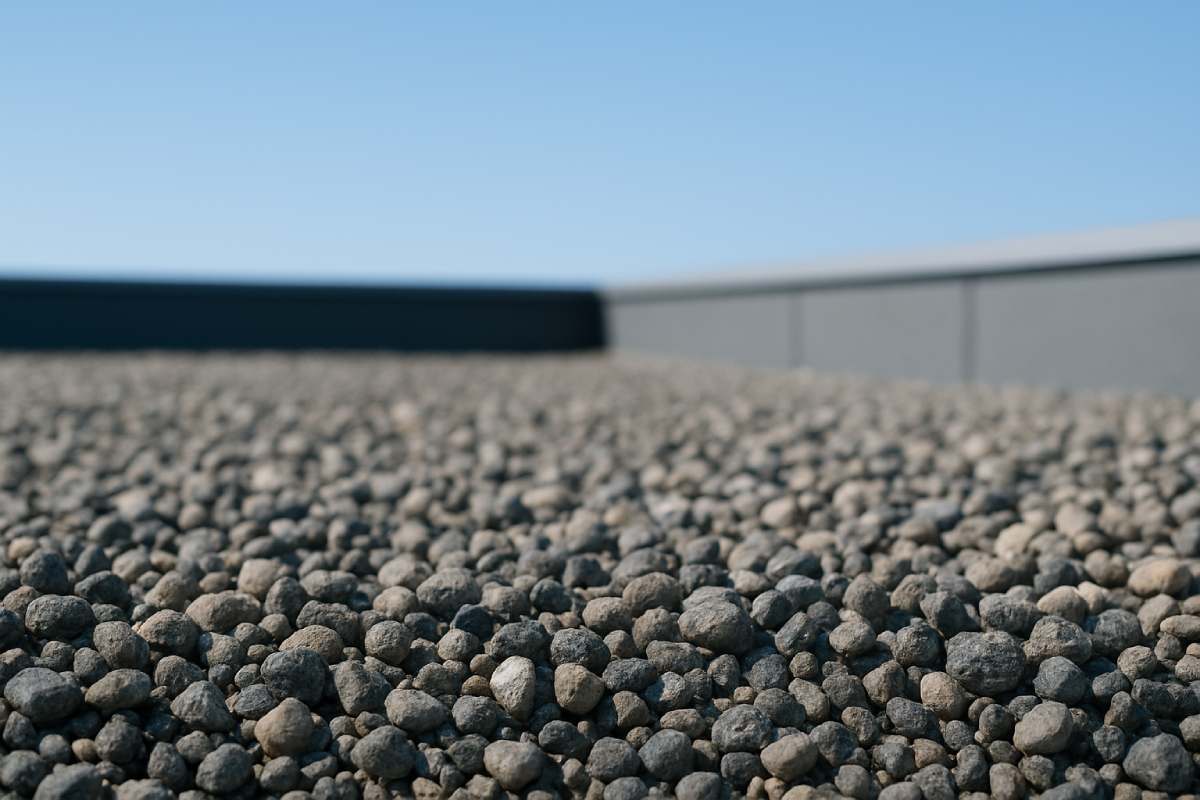
Ballasted single-ply roofing covers a significant portion of Dallas's pre-2000 commercial building inventory. We rarely spec it new — the structural load, future repair complications, and reroof sequencing costs argue against it in most modern applications. But we remove and replace a lot of it, and that process has specific requirements that owners need to understand before signing a contract.
Ballasted roofing — a loose-laid single-ply membrane (typically EPDM or early TPO) held down by 10-12 pounds per square foot of river-wash stone — was common in Dallas commercial construction from the late 1970s through the mid-1990s. The system was simple, fast to install, and provided inherent hail and UV protection to the membrane. The older industrial buildings in the Redbird area in southern Dallas, the distribution centers off Walton Walker Boulevard, and commercial buildings in the Duncanville Road corridor frequently carry original ballasted EPDM from that era.
That inventory is reaching end of life at the same time that owners are discovering the costs that ballasted systems impose on reroof projects. Removing 10-12 psf of stone from a 100,000 sq ft building requires significant labor, waste-container staging, and in some buildings, structural engineering sign-off on the temporary load condition during removal. This is not a surprising discovery — it is a known variable — but it needs to be in the project scope upfront so it is not a cost-overrun surprise during production.
We assess ballasted roofs the same way we assess any other system — moisture cores, deck inspection, drain assessment, parapet walk — but with the additional step of estimating the ballast removal cost before any other scope decision. Ballast removal adds measurably to the project cost and schedule, and that factor shapes whether recover or full replacement is the economically rational scope.
Ballasted single-ply made sense in an era when structural capacity was designed with generous margins and future reroof costs were not factored into the original specification. Modern Dallas commercial construction is engineered closer to structural minimums, and the 10-12 psf dead load of a ballasted system frequently cannot be accommodated without structural uprating. That cost alone removes ballasted systems from most new-construction specifications.
The future-cost argument is equally significant. A building owner who installs ballasted roofing today is committing their successor to ballast-removal cost in 25-30 years. The stone has to come off during reroof — it cannot be left in place under a new system without voiding the new warranty and potentially exceeding structural limits. That future obligation is real and quantifiable, and we include it in the lifecycle cost comparison when an owner asks whether ballasted is worth considering.
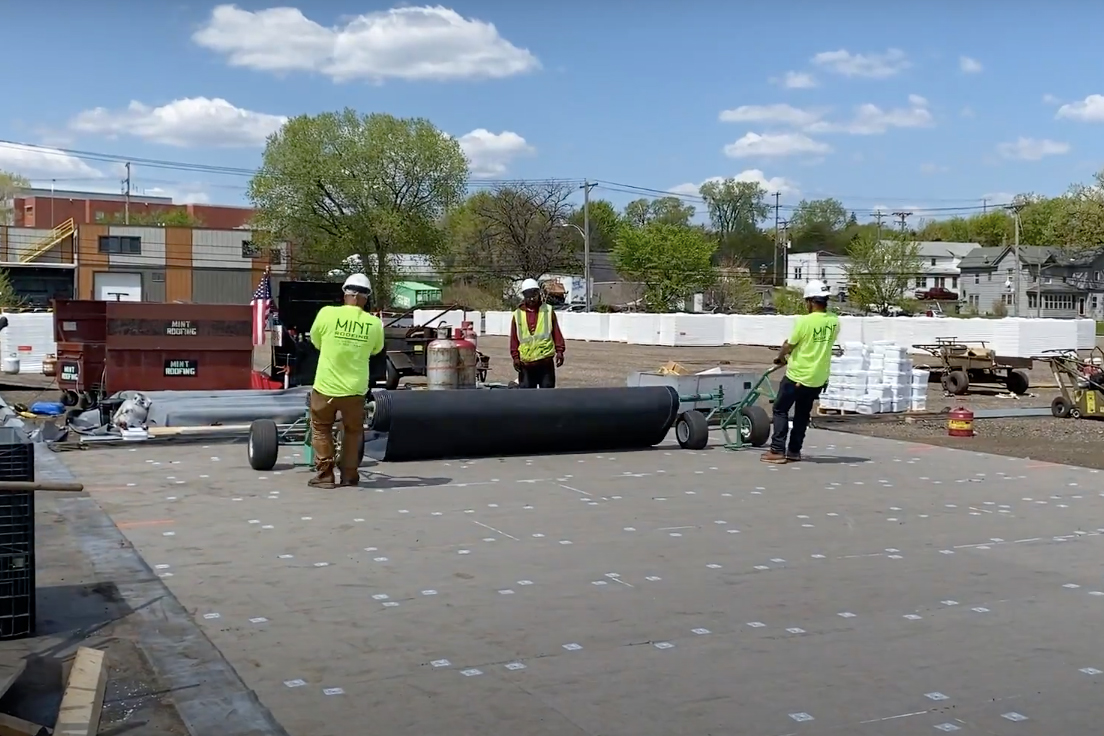
Ballast removal on a Dallas commercial reroof is a distinct production phase that runs before the membrane can be removed. The sequence: mark the drain locations, establish a material staging area (typically a waste container at the building perimeter or on a loading dock), remove ballast in 5,000-10,000 sq ft sections keeping pace with the membrane removal and dry-in crew, haul stone to the staging area, and dispose of or repurpose the stone. River-wash stone is sometimes reused by the building owner for site landscaping — we stage it separately if the owner wants to recycle it.
The labor cost for ballast removal is typically $0.25-0.40 per pound of stone, or roughly $2.50-$4.80 per square foot of roof area. On a 100,000 sq ft building with 1.2 million pounds of stone, that is $300,000-$576,000 in removal cost alone, before any membrane or insulation work. Owners who receive a scope without an explicit ballast-removal line item should ask specifically how the contractor is handling it — underscopped ballast removal is one of the most common change-order generators in Dallas commercial reroof work.
Assessing a ballasted system requires pulling stone back from representative areas to expose the membrane below — you cannot evaluate a ballasted roof from the surface because the membrane is hidden under 4-6 inches of stone. We pull ballast from 8-10 locations across the roof, expose the membrane, and inspect seam condition, membrane flexibility (brittleness indicates end of UV life even though the membrane was shielded from UV), and lap adhesion.
Moisture cores on ballasted systems go through the stone (which we temporarily move), through the membrane, and into the insulation below. Wet insulation under a ballasted system is a common finding on roofs in the 30-40 year age range — the stone accumulates debris at the drain areas, the drains restrict, and water sits on the membrane for extended periods rather than draining freely. By the time the owner notices a leak on the interior, the insulation may have been wet for years. This is an argument for periodic ballast-removal inspection on aging ballasted systems, not just monitoring from the surface.