Expansion joints fail when they are filled, bridged, or covered with a material that cannot accommodate the movement they were designed to absorb. In Dallas, Blackland Prairie clay amplifies that movement seasonally.
Expansion joints in commercial buildings exist because no building material — concrete, steel, masonry, or roofing membrane — can accommodate the full range of thermal and structural movement a large building experiences without cracking or tearing. The joint is a designed gap, typically one to three inches wide, that allows adjacent building sections to move relative to each other. The roof expansion joint cover is the flexible assembly that spans that gap at the roof surface and keeps water out while the joint opens and closes beneath it.
Dallas commercial buildings built on Blackland Prairie clay — which is most of the commercial inventory east of the Trinity River, including the bulk of the industrial and office stock in Garland, Mesquite, Balch Springs, and eastern Dallas — experience seasonal structural movement that is larger than what most designers anticipate from thermal cycling alone. The Blackland Prairie clay shrinks during dry summers and expands during wet winters, producing vertical and horizontal movement in building foundations that translates into stress at expansion joints. Buildings without expansion joints in their roofing system develop cracks in the membrane at structural transitions. Buildings with expansion joint covers that are rigid, failing, or improperly detailed see those covers pulled apart or compressed into the joint until the cover itself becomes the leak source.
We repair and replace expansion joint covers on Dallas commercial buildings using EPDM and TPO bellows cover systems that are engineered to accommodate the movement range the building actually experiences — not just the thermal movement range the joint was originally specified for. Every expansion joint repair we do starts with measuring the joint width in two seasons or at two different times of year to understand the movement range before we specify a replacement cover.
EPDM bellows covers are the most common system on Dallas commercial buildings built through the 1990s. The bellows — a flexible loop of EPDM that spans the joint opening — accommodates horizontal movement by extending or compressing. The cover is mechanically terminated on both sides of the joint with metal bars embedded in the roofing membrane. When the termination bars separate from the membrane or the bellows tears, the joint leaks.
TPO heat-weldable expansion joint covers — available from Carlisle, Johns Manville, and other TPO manufacturers — are the current standard specification for buildings on TPO membrane systems. The cover is heat-welded to the field membrane on both sides of the joint, with a pre-formed TPO bellows spanning the gap. Because the cover is welded, not mechanically fastened, it integrates with the membrane system cleanly and eliminates the termination bar as a failure point. On buildings where we are replacing an EPDM bellows cover on an existing TPO roof, we typically specify the TPO heat-weldable cover system so the entire assembly is one membrane type.
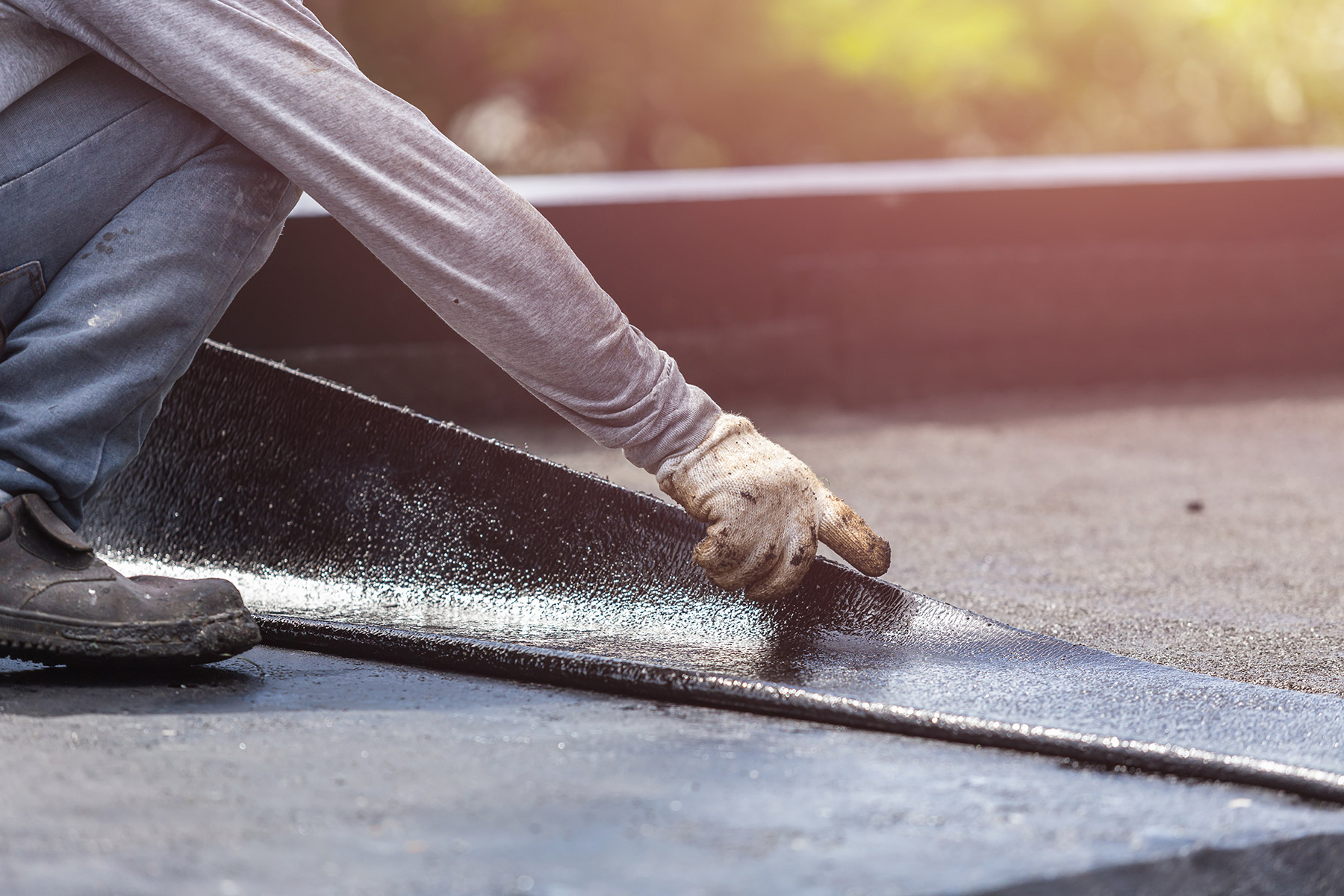
For joints on buildings with existing modified bitumen or BUR systems, we use a preformed expansion joint cover in a modified bitumen-compatible formulation, torched or hot-mopped into the surrounding membrane. These systems are less flexible than single-ply bellows covers and require more careful movement range estimation — if the cover is undersized for the actual joint movement, it tears at the center.
The Blackland Prairie clay that underlies most of the eastern Dallas metropolitan area has a plasticity index that ranks among the highest in the United States — the clay swells and shrinks more dramatically with moisture change than the expansive clay found in most other Texas cities. Foundation movement from clay shrink-swell cycles is documented by the Texas Department of Transportation as a primary cause of infrastructure distress on roads and bridges across North Texas, and it produces the same stress in building structures.
We assess clay movement risk on every expansion joint repair project by reviewing the building's foundation type (pier-and-beam foundations on drilled piers that extend below the active clay zone move less than slab-on-grade foundations), the building's moisture management history (buildings with poor site drainage have wetter soil and more variable movement), and the visible evidence of differential movement in the existing joint (gaps that are wider on one side than the other, covers that show compression on one face and tension on the opposite face).
For buildings where we determine that clay movement is the primary driver of joint failure — rather than simple age degradation of the cover material — we specify a cover system with a bellows depth and width that accommodates the seasonal movement range plus a safety factor. We also discuss with the building owner whether improving site drainage around the building's perimeter would reduce the soil moisture variation that drives the movement, because a drainage improvement that stabilizes soil moisture is sometimes more cost-effective than repeated cover replacements.